
Email and attachments as content items
Incoming emails and their attachments become classified, reviewable content items automatically.
What it is
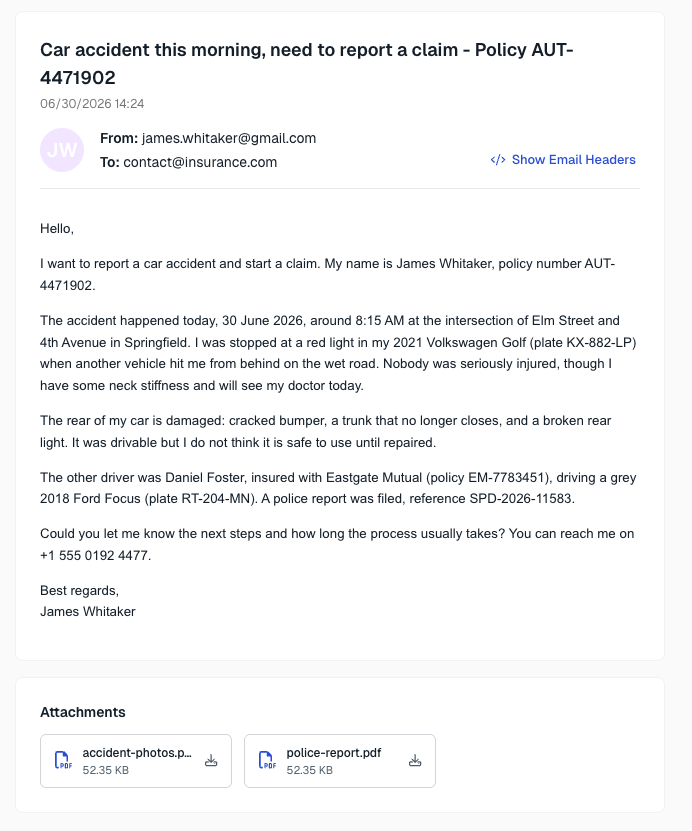
Inbound email is one of the most common ways unstructured work arrives, and it usually carries the real payload as attachments. Flowable Work can now turn each incoming email, and every file attached to it, into a content item the moment it is received. You enable content-item creation on the inbound event or on the case start configuration, and from then on the message and its attachments are captured as first-class content rather than left as raw mail.
Each created item can be assigned a content model, mapping an email or attachment to the model that describes it. The items are reviewable directly in the attachments table, which now includes a dedicated email detail view, and the original HTML body of the received email renders in the email preview.
Included in the Flowable Case Platform:
- Automatic creation of content items from incoming emails and their attachments.
- Assign incoming emails and attachments a fixed content model.
- A dedicated email detail view in Flowable Work for reviewing captured mail.
- Persistence of inbound email content items to process and case variables, with each attachment stored as its own content item.
With the Agentic Case Platform
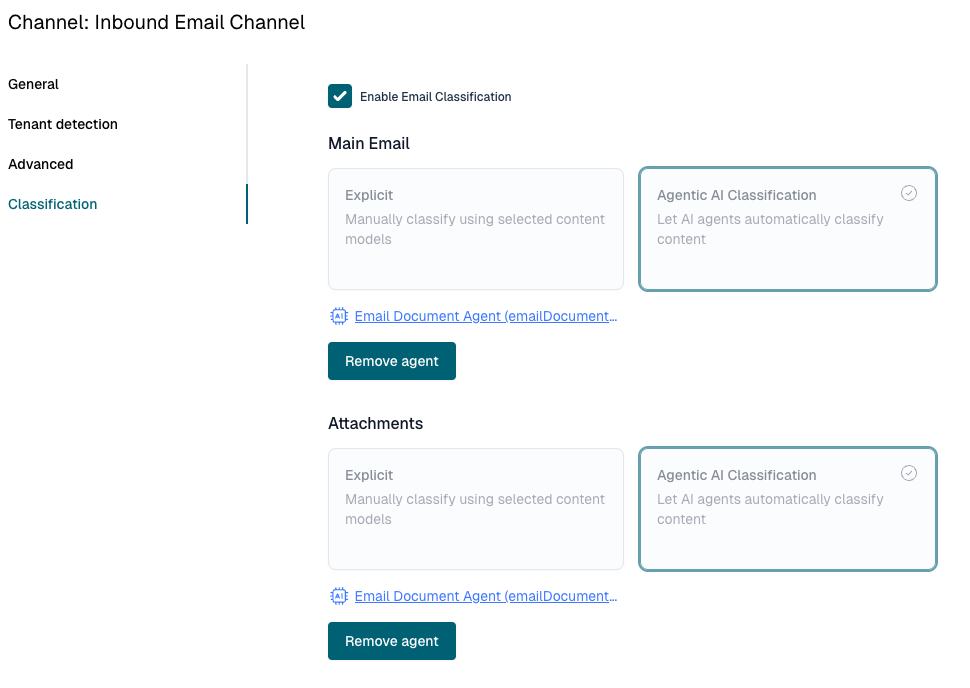
On the Agentic Case Platform, classification does not have to be hard-coded. You can hand an incoming email and its attachments to a document agent that works out what each item is and extracts its structured fields automatically, so the work arrives already understood instead of waiting for someone to classify it.
Added with the Agentic Case Platform:
- Automatic classification of incoming emails and their attachments by a document agent.
- Structured data extraction from emails and attachments, with the document agent pulling the content of the documents into their metadata.
- A per-channel choice of agentic classification for the email body and for the attachments.
Why it matters
Most knowledge work still starts in an inbox, and the data is locked inside attachments. Capturing email as classified content items at the point of arrival means the work is structured from the first second, ready for an agent or a person to act on, instead of sitting as an opaque message that someone has to open, triage and re-key by hand.
Example
A shared mailbox receives requests with supporting paperwork attached. As each email lands, Flowable Work creates one content item for the message body and one for every attachment, classifies the attachments against the relevant content models, and starts a case with those items already linked. A reviewer opens the case, sees the original email rendered in the preview alongside the classified documents, and moves straight to the decision rather than the data entry.